The Infamous GTA V AMD Artifact Bug: A 2026 Look Back at a PC Launch Disaster
GTA V's notorious AMD artifact corrupted screens with a shimmering fractal glitch when MSAA was enabled. It became a legendary PC gaming bug.
Back in 2015, the PC gaming world was ablaze with excitement. Grand Theft Auto V finally made its long-awaited debut on personal computers, promising superior graphics, higher frame rates, and a level of detail console players could only dream of. The hype was real, the pre-loads massive, and players dove headfirst into Los Santos with reckless abandon. But for those with AMD graphics cards, the initial launch delivered not only a breathtaking open world, but also a bizarre and infuriating visual nightmare that would become legendary in PC gaming history.
What was this nightmare? It wasn't a simple crash to desktop or a minor texture flicker. No, this was something far more trippy. As soon as players toggled on MSAA (Multisample Anti-Aliasing) – even at a modest 2x setting – the bottom-right corner of the screen transformed into a shimmering, fractal-like mess of corrupted graphics. Imagine taking a bite out of reality and seeing digital static ooze out of the wound. That’s precisely what thousands of AMD users experienced.
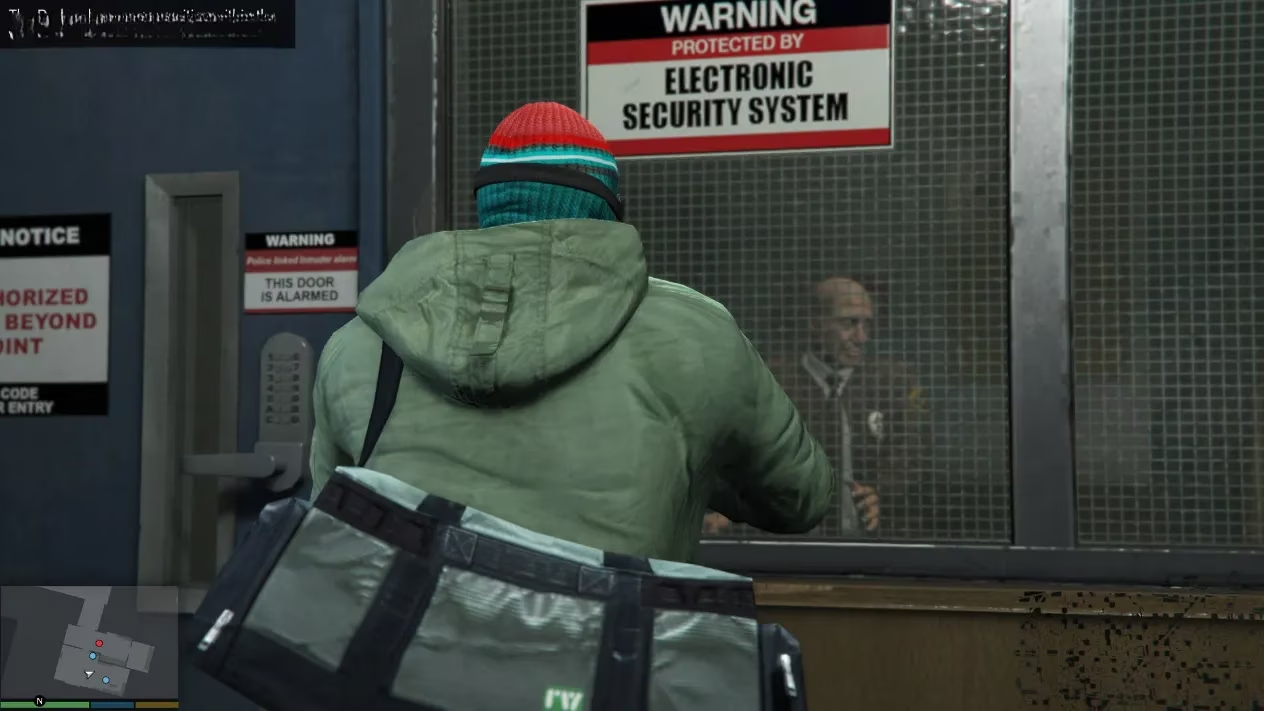
Now, you might be wondering: why would turning on anti-aliasing cause such a spectacle? After all, MSAA is supposed to make edges smoother, not summon graphical demons. The core reason lay in how certain AMD GPUs handled the rendering pipeline when multiple samples per pixel were requested. The exact technical fault was never officially detailed by Rockstar or AMD, but the community quickly pinpointed the trigger: with MSAA on, the game’s deferred rendering engine produced memory corruption in the frame buffer, specifically in that lower-right quadrant. It didn’t matter if you had a top-tier Radeon R9 290X or a humble HD 7870 – the artifact didn’t discriminate. It was equal-opportunity glitchiness.
The timing couldn’t have been worse. AMD had released a special beta driver literally the day before the game launch, boasting optimizations for GTA V. Fans assumed that driver would be their savior. Instead, the so-called “GTA V Ready” driver did absolutely nothing to fix the artifact. Forums like Reddit’s r/pcgaming and the AMD subreddit exploded with threads showing off the psychedelic corruption. Some tried to laugh it off: “Rockstar finally added acid trips to the game!” Others were less amused, especially those who had waited years for the PC version only to be greeted by a broken visual experience.
But wait – weren’t there other issues plaguing the launch? Oh yes. The article that broke the news also mentioned widespread crashes, installation failures, and stuttering that plagued even NVIDIA users. The AMD artifact, however, stood out because it was so visually distinct and reproducible. You couldn’t just ignore it by lowering a shadow setting; your only solution was to permanently turn off MSAA, effectively downgrading your image quality. For players with high-end rigs who invested in powerful graphics cards specifically for max settings, this was a bitter pill to swallow.
So what did players do? The immediate workaround was simple: disable MSAA entirely or use FXAA (which looked far worse). Some explored injectors like SweetFX to force SMAA, but that wasn't a native, hassle-freefix. The community held its breath for a patch. Neither Rockstar nor AMD offered a timeline. Days passed. Memes flourished. One popular image macro showed a medieval painting with the bottom-right corner replaced by GTA’s artifact, captioned “When thou enableth MSAA on thine Radeon.”
Then, finally, salvation arrived. Within a week, Rockstar dropped a patch that specifically addressed the AMD MSAA artifact, along with a host of other stability improvements. AMD also issued another driver update that further ironed out rendering inconsistencies. The corrupted corner of doom was vanquished – but the scar remained in the memories of early adopters.
Looking at this incident from 2026, it’s hard not to chuckle. GTA V has since become one of the most polished and enduring PC titles ever, constantly updated for newer hardware. The artifact bug is now a distant legend, a cautionary tale whispered among veteran PC gamers. Yet, it serves as a perfect time capsule of the wild west era of PC launches. Back then, day-one drivers were make-or-break, communication between hardware vendors and developers was sometimes chaotic, and Reddit threads were the real patch notes.
Could such a bug happen today? Absolutely. Despite advances in driver testing and game APIs like DirectX 12 and Vulkan, PC ecosystem complexity means specific hardware combos can still produce bizarre artifacts. But the response would be far swifter, with hotfixes rolling out in hours rather than days. The GTA V AMD artifact reminds us that even the biggest blockbusters can stumble, and that the PC community’s relentless bug-reporting and meme-making are part of the culture that ultimately makes games better.
For those who missed the hysteria, the screenshot above remains a perfect visual summary. That kaleidoscopic corruption in the bottom-right was both maddening and mesmerizing – a testament to what happens when rendering math goes horribly, beautifully wrong. Next time you boot up Los Santos in glorious 4K with MSAA cranked to 8x, spare a thought for the pioneers who once stared into the abyss and turned it off.