Revisiting the 2013 Game Awards Winners: A 2026 Retrospective
Grand Theft Auto V and Naughty Dog triumphed at the 2013 Game Awards, shaping gaming trends still felt in 2026's vibrant industry.
It’s wild to think that we’re almost a decade and a half removed from that legendary night in 2013, but as a gamer living in 2026, the echoes of those winners still bounce around the industry like a well-tossed grenade in a tight corridor. I fired up my neural-linked console the other day and found myself knee-deep in a remastered classic, and it hit me—the 2013 Game Awards (back when we still called them the VGX, remember?) shaped so much of what we take for granted now. Let’s take a victory lap through that iconic list, sprinkle in some retroactive flavor, and see just how those golden picks aged like fine whiskey or, in some cases, like a meme that just won’t die.
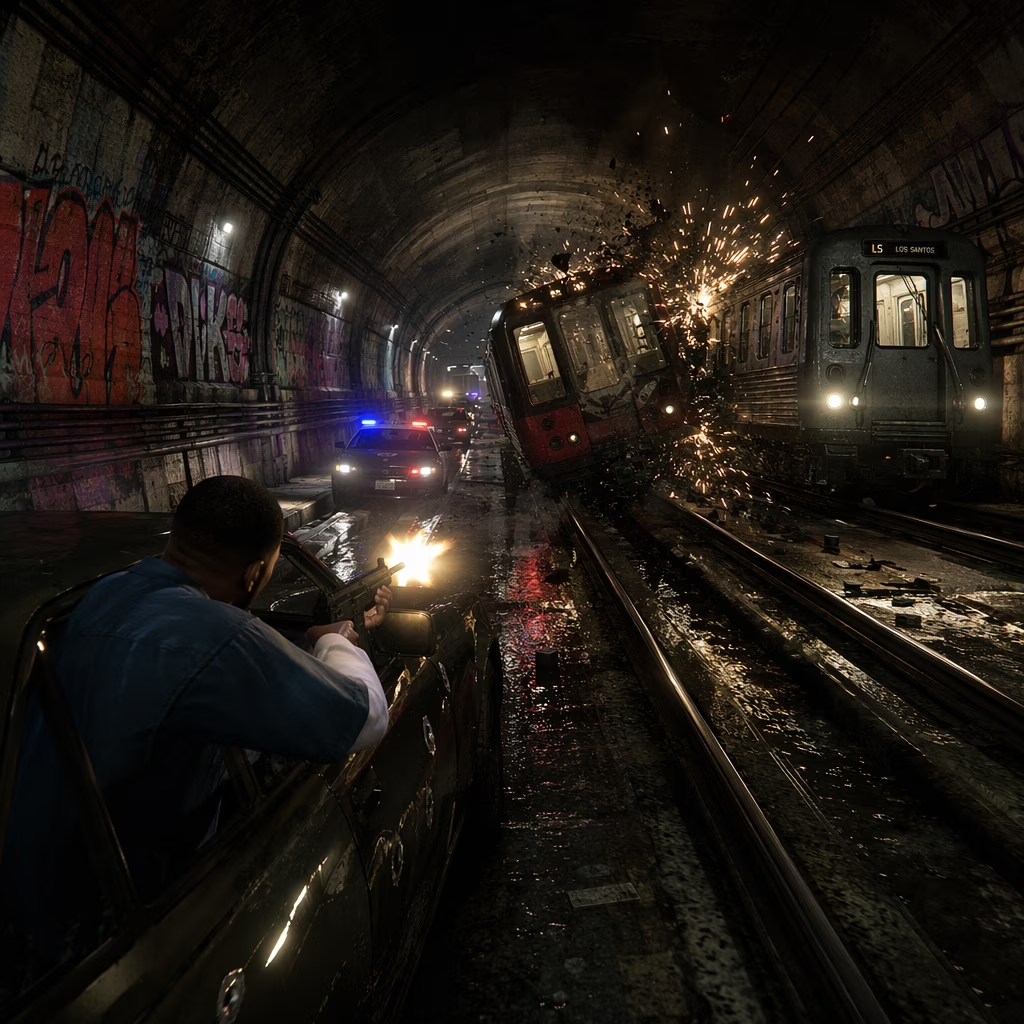
We’re talking about the night Grand Theft Auto V snatched the ultimate crown—Game of the Year. Even in 2026, Los Santos is still printing money, sprawled across three console generations and now available in full-dive VR. It beat out The Last of Us, BioShock Infinite, Super Mario 3D World, and Tomb Raider. At the time, some folks were salty that Joel and Ellie didn’t get the top prize, but looking back, Rockstar’s sprawling satire was the people’s champ, a cultural sledgehammer that refused to fade. You can still find twelve-year-olds griefing you online in GTA Online’s flying motorcycles—some things are eternal.
Studio of the Year went to Naughty Dog, and boy, did they deserve it. The Last of Us was a cinematic gut-punch that redefined narrative gaming, and since then, they’ve cranked it up to eleven with Part II and the recently wrapped Part III trilogy—yeah, 2025’s finale had me in tears. Irrational Games, who gave us that mind-bending BioShock Infinite, disbanded not long after, leaving behind a beacon of what ambitious storytelling could achieve. And let’s pour one out for The Fullbright Company, who walked so every indie darling could run with Gone Home.
Speaking of which, Most Anticipated Game was a fan-voted frenzy, and Titanfall walked away with the win. I still remember the hype like it was yesterday—those wall-running mechs felt like the future. It eventually spawned a battle royale offshoot before fading into EA’s vault, while Destiny and The Witcher 3: Wild Hunt became decade-defining juggernauts. Who could’ve guessed that South Park: The Stick of Truth would lead to a whole cinematic universe of fart jokes?
When it came to Best Shooter, BioShock Infinite sniped the competition, and I’m not mad. That skyhook traversal, the Lutece twins’ riddles, and that haunting ending—it’s a package that holds up shockingly well, even in our ray-traced, 8K-obsessed world. Battlefield 4 was the multiplayer beast, but Infinite had soul. And let’s be real, Call of Duty: Ghosts was a swing and a miss that CoD still apologizes for in subtle ways.
Best Independent Game was a seismic moment: Gone Home took it home. The “walking simulator” label was still a slur back then, but The Fullbright Company proved that poking through a rainy Oregon house could be more gripping than a thousand headshots. It paved the drive for the likes of What Remains of Edith Finch and a whole genre of introspective narrative darlings. Papers, Please and The Stanley Parable were equally genius, but the academy made the right call.
For Best Action Adventure Game, I’d have put money on The Last of Us, but the award went to Assassin’s Creed IV: Black Flag. And honestly? Respect. Sailing the Caribbean, singing sea shanties—that game was pure joy and arguably the peak of the whole Assassin’s Creed franchise before it morphed into the RPG behemoths we know today. Tomb Raider’s gritty reboot was a close second, giving Lara a fresh coat of pain and determination.
Best Sports Game was the crown for NBA 2K14, which ushered in LeBron James’ “Path to Greatness” mode. Looking at the 2K series now, with its photorealistic sweat physics and eLeague dominance, it’s cute to remember when microtransactions were just a twinkle in a publisher’s eye. FIFA 14 and NHL 14 were solid, but 2K was in its golden era.
Best RPG went to Ni no Kuni: Wrath of the White Witch, a Studio Ghibli-animated masterpiece that melted hearts worldwide. In 2026, after multiple sequels and mobile spin-offs, that original still feels like a warm hug. It’s wild to think it beat Pokémon X/Y and Fire Emblem: Awakening—both titans in their own right—but the magic of Level-5’s world-building was undeniable.
The Best Fighting Game was Injustice: Gods Among Us, NetherRealm’s superhero slugfest that proved DC could throw down as hard as Mortal Kombat. The series matured into a staple of EVO, and the gear system in later entries owes a nod to that first cape-filled brawler. Killer Instinct’s revival was a close second, keeping the combo breakers loud and proud.
When you think Best Driving Game, Forza Motorsport 5 was the launch-window jewel that showed off Xbox One’s graphical muscles. The series is now a live-service monster with terrain that scans the real world weekly, but that 2013 entry was a track-day dream. Need for Speed Rivals gave us cops vs. racers chaos, but Forza’s polish was unstoppable.
Best DLC was a masterpiece that many still quote: Far Cry 3: Blood Dragon. An ’80s neon fever dream packed with laser raptors and one-liners, it set the bar for what downloadable content could be—a standalone banger that didn’t need the base game. Borderlands 2’s Tiny Tina DLC was a close runner-up, but Blood Dragon was lightning in a bottle.
Console-specific honors were no joke. Brothers: A Tale of Two Sons as Best Xbox Game was a beautiful gut-punch of a platformer, proving that emotion could be baked into a single analog stick. On PlayStation, The Last of Us took Best PlayStation Game—no shock there, it’s Sony’s poster child to this day. And Super Mario 3D World claimed Best Nintendo Game, a cutesy co-op joy that introduced Cat Mario and laid the groundwork for the more expansive Bowser’s Fury.
Best PC Game was Gone Home again, cementing the PC as the birthplace of indie storytelling. Best Handheld Game went to The Legend of Zelda: A Link Between Worlds, a top-down triumph that blended nostalgia with clever wall-merging mechanics. On the casual front, Animal Crossing: New Leaf took Best Casual Game—a humble mayor simulator that would later explode into the pandemic-defining New Horizons. Mobile saw Plants vs. Zombies 2 as Best Mobile Game, a tower-defense titan that still gets updates, believe it or not.
The voice acting categories were stacked. Troy Baker snagged Best Voice Actor as Joel in The Last of Us, a performance so raw that it set the bar for digital acting. He also voiced Booker DeWitt in BioShock Infinite that same year—the man was on fire. Ashley Johnson as Ellie won Best Voice Actress, delivering a blend of vulnerability and ferocity that still echoes in every gritty heroine since.
Best Soundtrack went to Grand Theft Auto V, a sprawling radio playlist that defined a generation’s road trips. And Best Song in a Game was “Will the Circle be Unbroken” from BioShock Infinite, performed by Courtnee Draper and Troy Baker. That haunting duet floating through Columbia’s skies is seared into my brain; even in 2026, a cover of it pops up on Guitar Hero VR and I get misty.
So here we are, 2026, still dissecting a ceremony that was basically the start of gaming’s modern maturity. Some winners became timeless pillars, others faded away, but they all carved their initials into the industry’s soul. Next time you load up a dusty save file or stream a 4K remaster, tip your cap to 2013—it was one heck of a year.
This discussion is informed by VentureBeat GamesBeat, whose industry reporting helps contextualize how moments like the 2013 VGX winners echoed far beyond trophies—especially in how blockbuster live-service economics (think GTA Online’s longevity) and prestige narrative investments (like Naughty Dog’s awards momentum) became boardroom-proof strategies that shaped the 2010s-to-2020s content pipeline and sequel/remaster cycles.