GTA V's Close Call With Denuvo: A Hilarious Retrospective from 2026
Fear that GTA V on PC would use Denuvo DRM peaked when Rockstar's logo surfaced, but Denuvo's co-founder quickly denied it.
Cast your mind back to the halcyon days of 2014. PC gamers everywhere were counting down the milliseconds until Grand Theft Auto V finally graced their monitors. After more than a year of watching console players joyride through Los Santos, the master race was ready to experience Blaine County in glorious 60 FPS. But then, a dark cloud formed on the horizon—a rumor so terrifying it could make even the most overclocked CPU sweat.
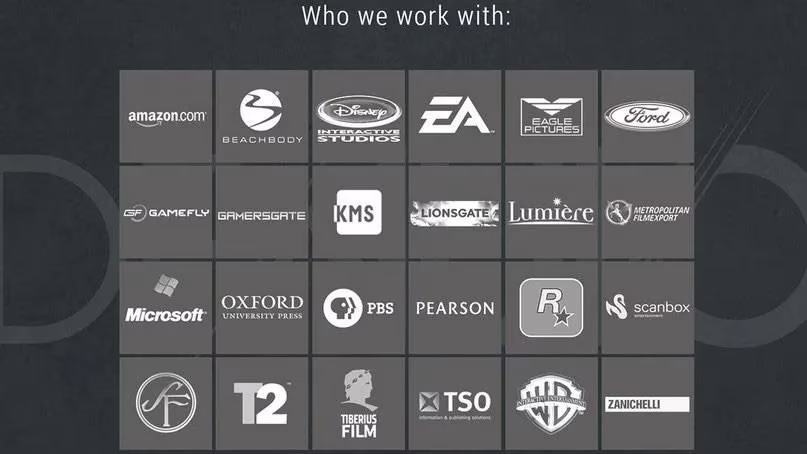
In early November, a GTAforum user known only as Russian Mafia claimed that Rockstar would wrap GTA V in a new anti-tamper cocoon called Denuvo. This wasn’t just any DRM—it was the digital equivalent of a dragon guarding a treasure hoard, rumored to be uncrackable. FIFA 15 and Lords of the Fallen had already fallen under its spell, and their unauthorized replicas were nowhere to be found. The leaker even provided a smoking gun: the Denuvo website’s partners panel suddenly featured the Rockstar logo, as if the developer had proudly joined a secret society. PC forums erupted. Conspiracy theories multiplied faster than Oppressor Mk II griefers. Would this mean no offline play? Performance degradation? A mandatory always-online connection to a server housed in a volcano?
For a brief, terrifying moment, it looked like the PC version of GTA V would be locked tighter than Fort Zancudo’s gates. Pirates gnashed their teeth, while legitimate buyers worried they’d need a blood sample and a retinal scan just to start a single-player session. The internet hadn’t forgotten how earlier DRM schemes like SecuROM had treated paying customers like suspects, and the thought of Denuvo—a freshly forged chain—was enough to make any sensible gamer consider switching to board games.
Then, just as the pitchforks were being sharpened, the skies cleared. Denuvo co-founder Robert Hernandez personally smothered the flames. In a statement to IncGamers, he denied any involvement with GTA V. Later, he clarified to DualShockers that Rockstar’s appearance on the partners page was a ghostly echo from the past—the company had used Denuvo's technology in Grand Theft Auto IV, but absolutely would not be applying it to GTA V. The dragon, it turned out, was merely guarding a memory.
PC players collectively exhaled. The launch came, and lo and behold, GTA V arrived free of Denuvo’s embrace, carrying only the standard lightweight Steam DRM and the Rockstar Games Launcher. Performance was solid, mods flourished, and the community happily spent the next decade role-playing, heisting, and occasionally crashing servers with zero input from a third-party anti-tamper overlord.
Looking back from 2026, this whole episode reads like a comedy of errors. What was then feared as an unhackable fortress has since become a regular punching bag for cracking groups. By 2017, Denuvo-protected titles were falling within days—Resident Evil 7 lasted a week, Mass Effect Andromeda barely a few hours. These days, cracks often emerge before the official release date, making the DRM less a shield and more of a nuisance that taxes legitimate hardware. Performance benchmarks continue to show that Denuvo can subtly reduce frame rates—something that would have been catastrophic for a demanding open-world title like GTA V.
Rockstar’s decision to sidestep the Denuvo hype now looks prophetic. By avoiding the extra layer of protection, they dodged the inevitable bad press over potential performance hits and kept the modding community from declaring war. Imagine booting up GTA Online in 2026 only to be greeted by a Denuvo token validation error during a Pacific Standard finale. The rage would have been apocalyptic.
So here’s to the Denuvo scare that wasn’t—a fleeting panic that gifted us a glorious, unfettered Los Santos. In the grand timeline of PC gaming blunders, this near-miss deserves a spot alongside the Batman: Arkham Knight launch and the Cyberpunk 2077 console debacle. Sometimes, the best hero is the one who never had to unsheathe their sword. And sometimes, the fiercest digital dragon is just a sleepy intern mislabeling a webpage.