GTA Online Made Me Eat Asphalt: A Love Letter to Wonky Walking
GTA Online character movement feels hilariously awkward, as Rockstar’s physics-driven design turns every step into chaotic comedy.
In 2026, Los Santos is still a place where the sunsets are gorgeous, the cars are stolen, and my character walks like a shopping cart with a bent wheel. I am back in the docklands, working a Bottom Dollar Bounty contract. The target is Angel Kenney, a Lost MC chapter member with a rap sheet longer than a GTA loading screen: theft, stalking, harassment, extortion, vehicular manslaughter, and at least one drunk and disorderly. Jenette, my handler, drawls that the last one sounds fun. Except, she notes, it led to the one before it. Fair point. Armed with nothing but confidence and super heavy body armour, I head into the clubhouse.
The clubhouse is a deathtrap. Tight angles, jagged corners, nooks that could hide a perp with a shotgun and a grudge. My fellow bail enforcement officer trains her weapon on a door and asks me to open it. A simple nudge would have sufficed. Just a slight bump to pump those hinges and expose the armed bikers in the next room. Instead, I push forward and then back on the thumbstick. My avatar swans through the portal into the firing line, pulling off a glacial 360-degree spin. Imagine Grandpa Simpson in the famous gif—slowly plucking his fedora from the hatstand as he rotates in the lobby of the burlesque house—only under a hail of submachine gun fire. My super heavy body armour is immediately shredded like wet tissue paper at a toddler's birthday party. It is the opposite of Rainbow Six: less breach and clear, more breach oh-dear. It is also standard fare for anyone getting to grips with the not-so-simple act of walking around in GTA Online.
A few years ago, I talked to Patrice Désilets about the creation of Assassin's Creed. Back then, in the mid-noughties, his team was looking at the work Rockstar had done to make open worlds a delight to bounce around in. He told me that exploring GTA, his pleasure was just to be in this game world and see the sun rise. So it was like: can we replace the car with the main character? In GTA I can go anywhere with the car, can I go anywhere with the character? That is why we had the parkour. The attempt to transpose that feeling of freedom was successful, to the extent that Assassin's Creed became Ubisoft's most dominant series—leaving the likes of Driver, the company's more direct rival to GTA, in the dust. But as part of the process, Désilets' team ditched the physics of Rockstar's driving model for something more controlled and athletic—the point-to-point leaping we now associate inextricably with Altaïr and Ezio.
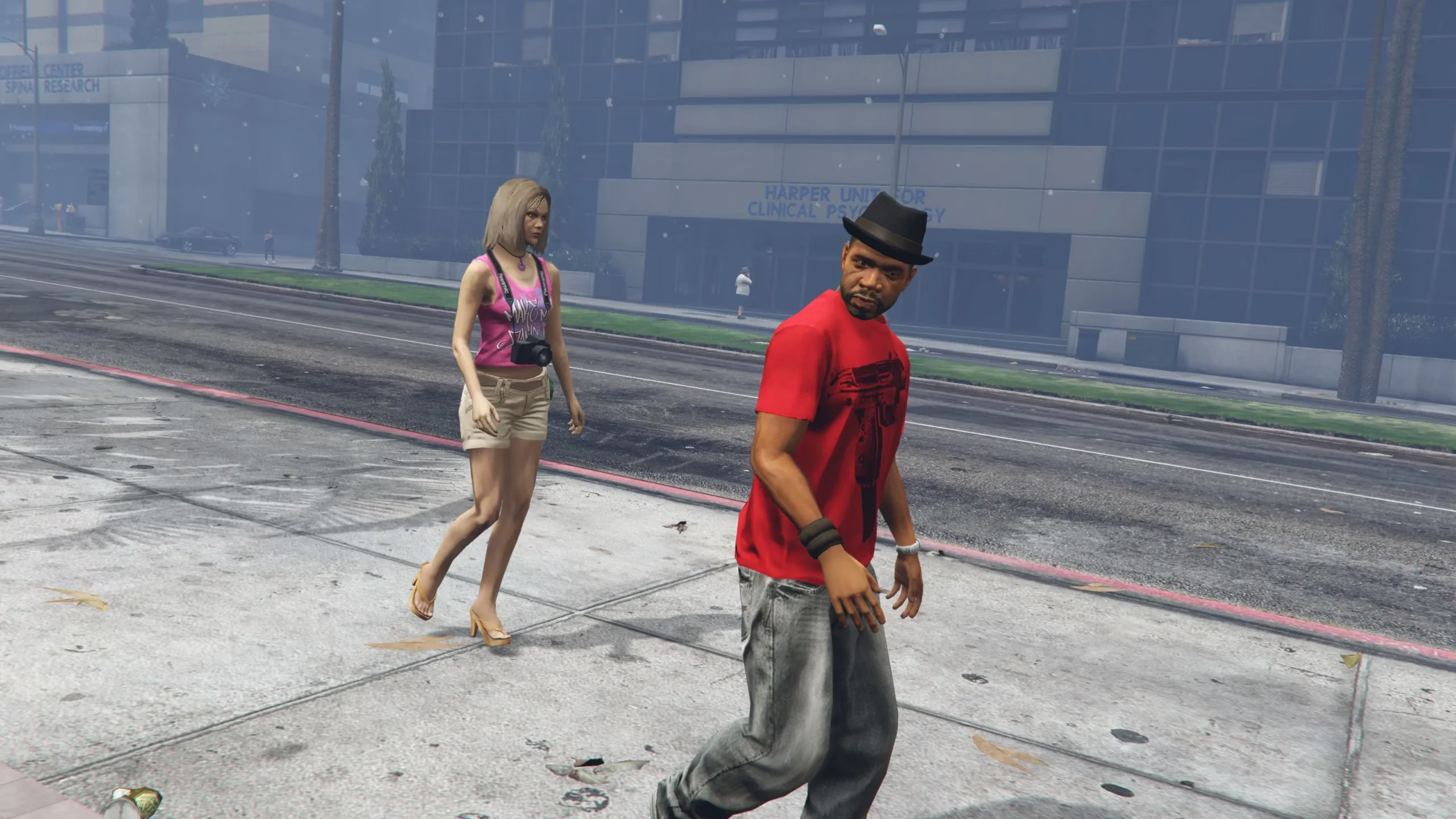
When I play GTA 5 and its online counterpart, by contrast, a part of me feels as though I am literally driving a car, even when my character is on foot. That is because pedestrians in Los Santos, the protagonist included, are subject to the forces of physics—in a fashion that is alien to most third-person action games. If you are steering Geralt, or Nathan Drake, or Spider-Man, you are given the final say over when your character starts and stops moving. It is the sort of precision in control you take for granted. But if you are Trevor, or Franklin, or Michael, then you are dealing with concepts like acceleration and inertia. Work up a sprint by repeatedly tapping the run key—itself a unique anachronism from the days of the PlayStation 1—and you will find that taking a corner requires some forethought. It is common to overshoot a staircase or mission marker because you did not account for your turning circle. Walking in GTA Online is like piloting a zeppelin through a keyhole. You can do it, but the keyhole will remember.
As when driving a sedan through the uneven streets of Liberty City's Portland, it is all too easy to flip onto your head. In a typical action game, ragdoll physics is something that happens to other people: your enemies. But in GTA 5, Rockstar is happy to hand over responsibility for your body to the whims of gravity whenever you lose your footing. Stepping off a rooftop, only to watch The Walking Dead's Steven Ogg flip in midair like a piece of toast and land butter-side down on the tarmac, is a rite of passage for every new visitor to Blaine County.
These skull-cracking pratfalls and understeers are made palatable by two things: first, they are funny, and eminently clippable. Second, they are offset by the handful of mechanics that let you hack your way to something resembling authority over your avatar. One is the good old-fashioned take me to the nearest car button, a homing device that has been plonking players in the driving seat since 1997's Grand Theft Auto. Another is the cover key, gluing you to the next available wall; a third is the jump button that contextually lets you vault fences, so long as they are not too high. Between them, these conveniences let you pretend that GTA 5 and Online are not bizarre experiments with simulated movement, partway along the road to comedic physics games like QWOP and Octodad.
I think most of us have had moments of frustration while wrestling with the controls in Rockstar's latter-day games. But doing so is also fascinating, and gives me hope for the company's future. Most mammoth Western game companies, at the mercy of shareholders and enormous sales expectations, tend to sand off the stranger edges of their series to appease an imagined, median player in the crowd. But Rockstar has never done this, knowing that its cachet will ensure fans forgive and embrace its idiosyncrasies—whether that is eschewing fast travel in the face of industry norms, building combat encounters around auto-aim, or structuring GTA Online progression around the fake internet on your in-game phone.
Where the likes of Ubisoft would be castigated for asking the same of Watch Dogs players, Rockstar gets away with pushing its players to invest the time to learn new and wonky skills—even when that skill is walking to the end of the street successfully. On the whole, I think that is a good thing. But I also think I am owed $500 in super heavy body armour.
Here is a quick taxonomy of my GTA Online movement, because I have suffered for science:
| Action | What I expect | What actually happens |
|---|---|---|
| Open a door | Gentle nudge | Full pirouette into a firing squad |
| Vault a fence | Smooth parkour | Faceplant, then a slow get-up |
| Sprint around a corner | Sharp turn | Understeer into oncoming traffic |
| Climb a ladder | Climb | Climb, then fall for no reason |
| Walk down stairs | Walk | Ragdoll down stairs like a sack of potatoes |
And a few lessons I keep forgetting:
-
🚗 Your character is not a person. Your character is a car with anxiety.
-
🧭 The minimap is a suggestion, not a promise.
-
🛡️ Super heavy body armour is made of hopes and dreams.
-
🎯 Auto-aim is the only reason I have ever won a gunfight.
-
📱 The in-game phone is a portal to a parallel internet where everyone is a billionaire.
In 2026, with open worlds more polished than ever, GTA Online still feels like a beautiful, broken playground. The wonkiness is not a bug; it is the texture. It makes Los Santos feel physical, heavy, and absurd. Every time I swan into a room and eat a shotgun blast, I am reminded that Rockstar built a world where walking is a skill, and I am still a beginner. So yes, I will keep playing. I will keep dying. I will keep buying body armour. But Rockstar, seriously, that $500 is coming out of your next shark card.