Grand Theft Auto V and Online: A Decade of Dominance and Digital Evolution
Grand Theft Auto V and GTA Online achieved sustained digital relevance, fueling cultural impact and recurring revenue through microtransactions.
Looking back from the vantage point of 2026, it's almost surreal to trace the journey of Grand Theft Auto V. I remember the initial buzz in 2013, but what has unfolded since is a masterclass in sustained digital relevance. The game, a sprawling, satirical tapestry of Los Santos, didn't just launch; it embedded itself into the cultural and economic fabric of gaming. During a pivotal investor call years ago, Take-Two's CEO Strauss Zelnick laid bare the staggering metrics: the title had sailed past 90 million units shipped, fueled by the expanding install base of then-current generation consoles. But the real story, the one that has defined its second decade, was Grand Theft Auto Online. Zelnick revealed that a particular year, 2017, was its best yet, crowned by an "epic December" with more active players than ever before. This wasn't a fading star; it was a digital metropolis hitting peak rush hour, year after year. The online component consistently exceeded publisher expectations, becoming the titanic engine for recurring consumer spending through its microtransaction ecosystem. From a milestone of over 85 million units announced just months prior, the addition of roughly five million more during the holiday season showed a momentum that felt less like a sales curve and more like a perpetual motion machine.
The Unending Metropolis: GTA Online's Content Pipeline
Zelnick's announcement was a promise kept: Rockstar Games would continue to support Grand Theft Auto Online with a relentless stream of new content. And support it they did. From my perspective today, that commitment transformed the online experience from a robust multiplayer add-on into a living, breathing parallel universe. It became less of a game and more of a digital coral reef, constantly accreting new structures, lifeforms, and economies upon its foundational code. Heists, businesses, nightclubs, secretive agencies, and sprawling car meetups were layered on, each update acting as a new neighborhood in this ever-expanding city. The player base wasn't just playing; they were establishing digital livelihoods, forming crews, and engaging in a socio-economic simulation as rich as the single-player story. The fiscal success Zelnick highlighted was merely the financial echo of this profound cultural engagement. The microtransactions, often a point of contention, were the voluntary taxes paid by citizens to thrive in this neon-lit world, funding the continuous urban development we all enjoyed.
A Technical Odyssey Across Generations
The availability of Grand Theft Auto V across a spectrum of platforms—PS4, Xbox One, PS3, Xbox 360, and PC—was a strategic masterstroke that I believe cemented its longevity. Its initial release in September 2013 for the PS3 and Xbox 360 was a landmark event. But the subsequent launches for the enhanced PS4 and Xbox One in November 2014, and finally on PC in April 2015, were not mere ports. They were phoenix-like rebirths, each iteration rising from the ashes of previous hardware limitations with improved visuals, performance, and exclusive content for the online world. This staggered, multi-generational rollout ensured that the game never faced a true "end of life." Just as one console cycle waned, the game found renewed vigor on the next, capturing new audiences and giving existing fans reasons to double-dip. The PC version, in particular, unlocked a new dimension of creativity through mods and role-playing servers, which acted as unofficial, community-powered DLC, further extending the game's shelf life in ways Rockstar might not have initially anticipated.
The Legacy and The Lesson
As I reflect on this journey up to 2026, the legacy of Grand Theft Auto V and Online is clear. It redefined what a "live service" game could be long before the term became an industry buzzword. Its success is a composite image:
-
Narrative Brilliance: A single-player story of crime, satire, and broken dreams that remains a benchmark.
-
Technical Persistence: Seamless transitions across three console generations and PC.
-
Economic Alchemy: A free online mode that became a financial singularity, bending the traditional sales model around its immense gravitational pull of recurring revenue.
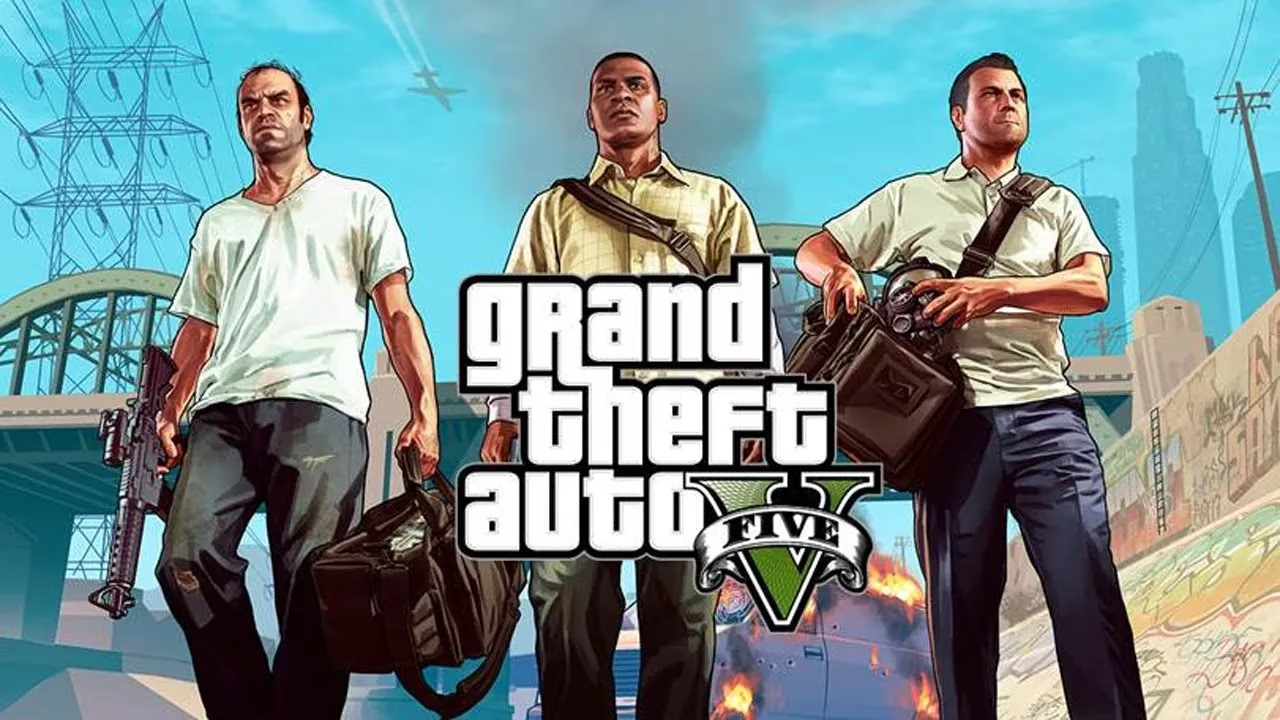
The image above, a snapshot from years past, still captures the essence: a world so meticulously crafted that it demanded to be lived in, not just visited. The numbers Zelnick shared—90 million, an "epic December," record active players—were not the conclusion. They were mile markers on a highway that seems to stretch indefinitely into the future. The true achievement of Rockstar and Take-Two wasn't just creating a best-selling game; it was in building a platform, a persistent state of play, that has outlasted trends, competitors, and even the hardware it was born on. For players like me, Los Santos transitioned from a setting we explored to a second home we helped shape, proving that in the digital age, the most valuable real estate isn't physical—it's persistent, pixelated, and perpetually online.