Grand Theft Auto Online: How Rockstar Turned Unused Ideas into an Ever-Evolving World
Grand Theft Auto V's discarded ideas became GTA Online's live-service goldmine, evoking a world that constantly evolves.
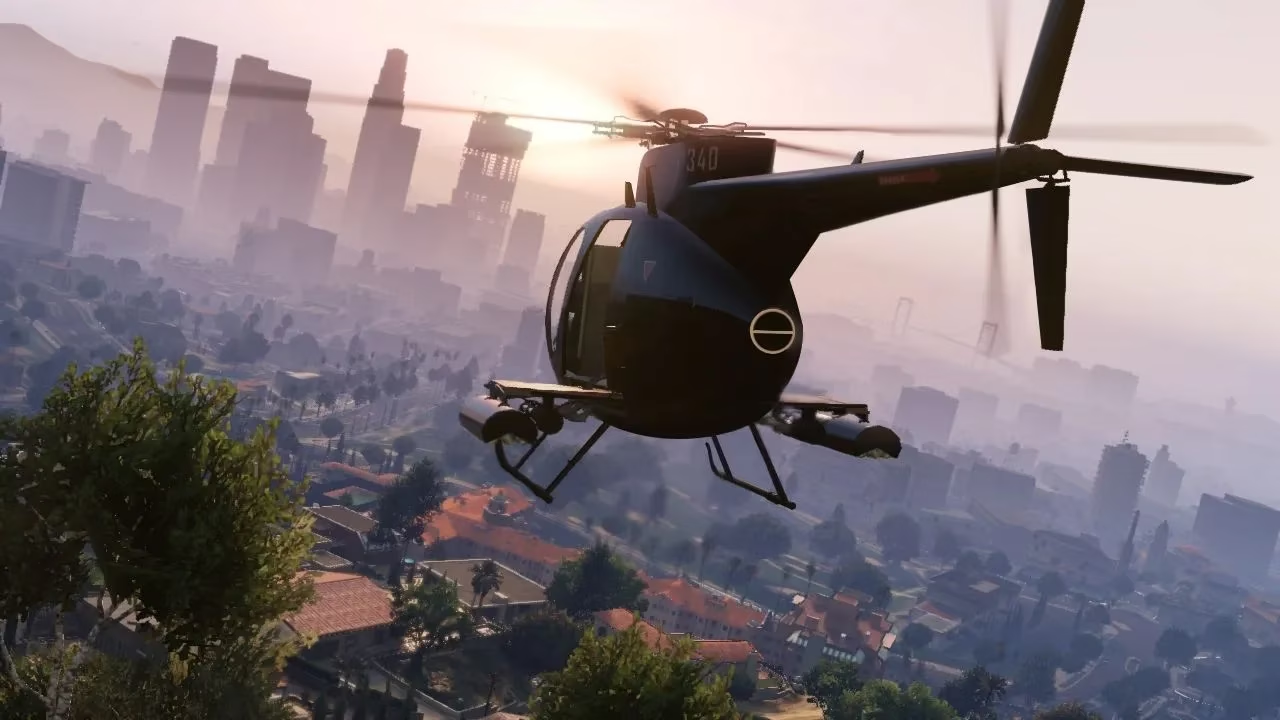
I still vividly recall the moment Grand Theft Auto V dropped in September 2013. Like millions of others, I was blown away by the sprawling recreation of Los Santos, the triple-protagonist narrative, and the sheer ambition of a game that seemed to contain an entire world. But what truly fascinated me back then wasn’t just what was on the disc—it was the promise of what was yet to come. Rockstar North’s Art Director Aaron Garbut spoke candidly about the cutting-room floor in an interview with Edge magazine, and his words planted a seed that would eventually redefine Rockstar’s entire approach to game development.
Garbut admitted, “There are always things that come up during development that you want to add. Often we do, but the closer you get to release, the less that happens. I don’t feel like the game fell short, but there is undoubtedly a huge volume of plans and ideas that we wanted to do to push it further.” For any studio, that might have been the end of the story—a list of cool concepts forever locked in a design document. But Rockstar had a secret weapon waiting in the wings: Grand Theft Auto Online.
Launched just two weeks after the main game, on October 1st, 2013, GTA Online was initially seen by many (myself included) as a fun but secondary multiplayer mode. How could a shared open world ever compete with the meticulously crafted single-player campaign? Yet Garbut hinted at something profoundly different. He emphasized that the online component meant “the game is no longer static. We can continue to add these things and evolve.” That single statement predicted the direction of not just GTA V, but the entire industry’s move toward live-service experiences. Fast-forward to 2026, and GTA Online is still thriving—a living, breathing entity that has absorbed countless abandoned single-player ideas and transformed them into billion-dollar gameplay.
Just think about it: how many of the features we now take for granted in Los Santos were originally planned for Michael, Franklin, and Trevor? The sprawling heists, the intricate business empires, the underground car meets, even the massive Cayo Perico island—these are not just multiplayer add-ons; they are the realization of concepts that could have easily been discarded. Garbut noted that the studio had “a huge volume of plans and ideas,” and GTA Online became the perfect playground to resurrect them. The Heists update, which finally arrived in 2015, felt like a lost chapter of the single-player story. The Doomsday Heist, the Diamond Casino & Resort, and the Contract featuring Dr. Dre—all of these could have been solo DLCs, but instead they flourished as collaborative experiences.
What made this evolution so organic was Rockstar’s growing connection with its player base. Garbut pointed out that through forums, Reddit, and social media, the developers had “a real direct connection to the people playing the game. We can respond to what they are into and what they hate more than ever.” In 2026, this feedback loop has become the lifeblood of GTA Online. I’ve seen the community beg for quality-of-life improvements, and within months, Rockstar delivers them. I’ve watched players theory-craft about new business ventures, only to see those exact ideas manifest as the latest update. This isn’t blind development; it’s a conversation.
But let’s be honest: can a game truly stay relevant for over a decade without risking stagnation? GTA Online’s answer is an emphatic no—because it refuses to stay static. By December 2023, the game had already seen the introduction of wildlife, new radio stations, and even Dr. Dre’s music integrated directly into the world. The Chop Shop update in late 2023 let players run a salvage yard, continuing the tradition of turning “what if” ideas into reality. And by 2025, Rockstar was still adding expansions like Agents of Sabotage, proving that the well of unused concepts was far from dry. The lesson here is clear: a game that never truly “finishes” can outlive its own original campaign.
I often wonder: what would GTA V have looked like if all those ideas had been crammed into the 2013 release? Probably a bloated, unfocused mess. By funneling that creativity into a persistent online world, Rockstar achieved two masterstrokes: they preserved the purity of the single-player narrative while simultaneously building a separate universe that feels endlessly rich. It’s a model that has since been emulated by competitors, but nobody has matched the sheer depth and longevity of Los Santos’ shared sandbox.
As we stand in 2026, with Grand Theft Auto VI (finally on the horizon), the legacy of GTA Online is undeniable. The next iteration will undoubtedly build upon this foundation, launching with a living world that can absorb everything Rockstar dreams up—whether it fits into the main story or not. Garbut’s words from 2013 now sound prophetic: “It’s something that really suits the way we work, the way we’re always trying to adapt the experience and avoid walking blindly down a set path.” For those of us who have spent thousands of hours in Los Santos, we didn’t just play a game; we watched a vision evolve in real time. And in an industry often criticized for moving on too quickly, GTA Online proved that sometimes the best ideas are the ones you wait for.
So here’s my question to you: when you log into GTA Online today and drive past a new business, or fly over a freshly added island, do you ever stop to think that it might have started as a line in a designer’s notebook from 2012? I do. Every single time.