A Lament for Lost Frame Rates
Relive the anticipation: Rockstar's 4K GTA V PC screenshots in 2015 made a two-month delay bearable, each pixel a promise of Los Santos.
I remember those winter evenings like a window left ajar in a memory palace—the cold air of expectation seeping through the chinks of every forum post. In early 2015, I was a humble congregant in the church of PC gaming, knees aching from patient prayer for Grand Theft Auto V to finally grace our monitors. January had been the promised month, a date circled in stolen office highlighters, but then came the news: a delay to March 24th. It was a papercut across the cornea of desire, tiny but searing. Yet, as if the developers at Rockstar understood the ache, they offered a poultice—a cascade of new 4K screenshots, each pixel a drop of digital morphine.
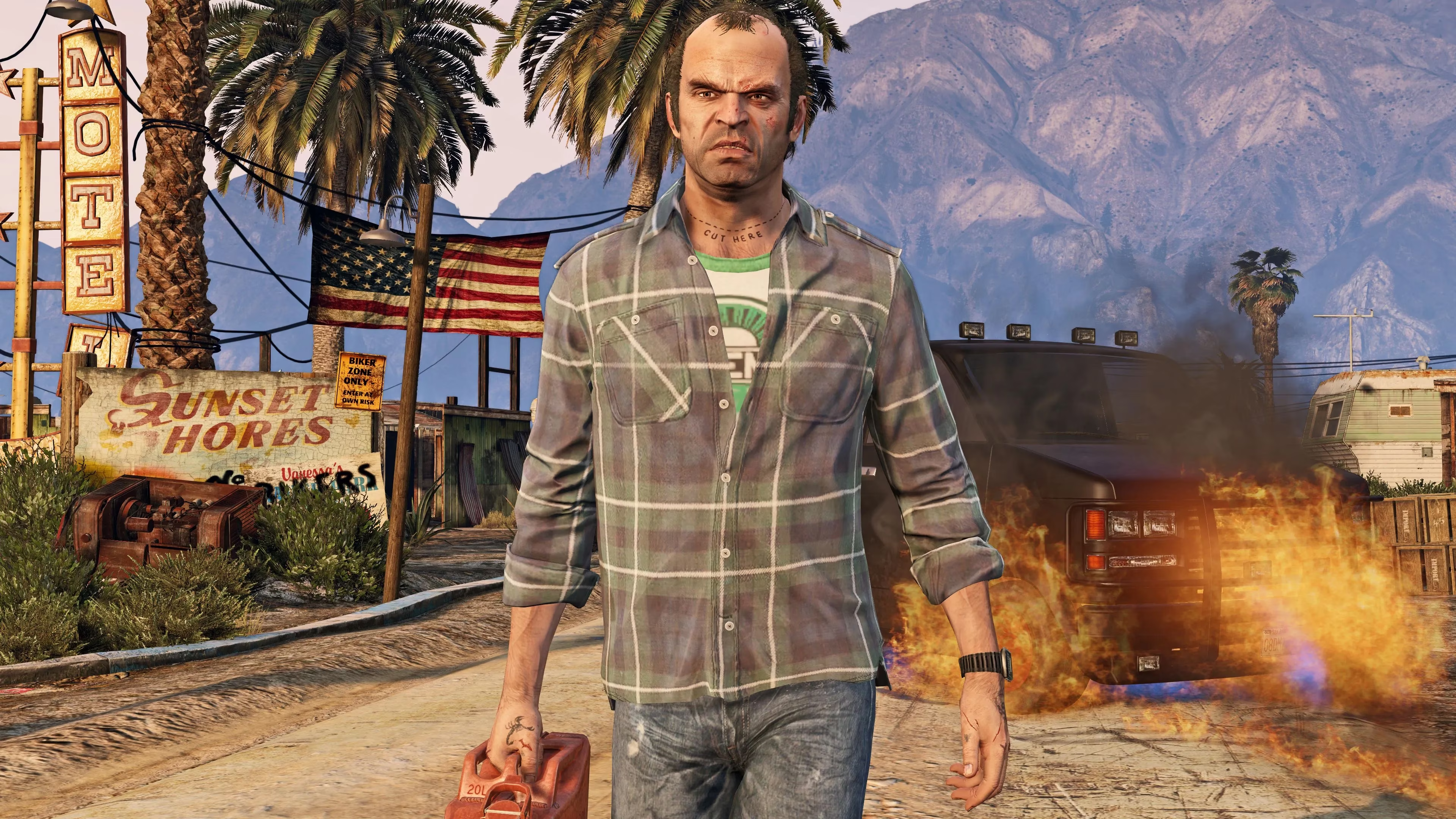
In that gallery, Los Santos shimmered like a city woven from light and regret. I gazed at Trevor Philips standing on a dirt trail, his silhouette a thundercloud of chaos, and the landscape behind him was a revelation. The resolution was so sharp you could almost feel the dust settle on your tongue. Rockstar boasted 1080p at 60 frames per second, support for true 4K, and even 3D capability with specific hardware. To my yearning eyes, those screenshots were not just images; they were promises etched in photon, a future where my graphics card would hum a lullaby of polygons.
The delay felt like a temporal refraction, a prism that split my anticipation into a spectrum of impatience and awe. I recall how the community dissected every frame: the way light bent around a car’s fender as if the sun itself were a sculptor, the fabric of a pedestrian’s jacket detailed enough to count threads, the briny texture of the ocean looking less like water and more like a vast, breathing sapphire. In one screenshot, the underbelly of a bridge at dusk held shadows so deep they resembled the dark side of a velvet moon. It was chiaroscuro rendered in code—Caravaggio with a GPU.
Now, in 2026, as I sit surrounded by the hum of my liquid-cooled rig and the faint scent of ozone from a monitor bright enough to shame stars, I look back on that two-month delay as a necessary vigil. Grand Theft Auto V on PC became a masterpiece that transcended its console origins. The modding community erupted like a coral reef after a volcanic event, spawning everything from photo-realistic enhancers to absurd flying cat cars. That initial gallery of screenshots was the seed of an ecosystem. I often think of it as a tide chart for digital wanderers: the frames were high, the patience low, but the tide eventually rolled in with the weight of an ocean.
Back then, those images were the first taste of a meal that was still cooking. The 4K screenshots weren’t just marketing; they were a love letter written in the syntax of anti-aliasing. I remember one particular shot of the Vinewood sign, its white letters sharp as fractured bone, the hills behind it rolling away like a green velvet blanket tossed by a giant. It felt like the game was breathing, waiting to be inflated with my own stories. The promise of 60 frames per second meant motion that would flow smoother than silk slipping off a glass statue. In an industry now obsessed with path tracing and neural rendering, it’s easy to forget how revolutionary that moment was—the first time a sprawling open-world crime epic was going to stretch its legs on the infinite treadmills of our PCs.
The greatest gift of that delay was the temporary blindness it cured. Before the screenshots, we were blind supplicants, feeling only the shape of the game through secondhand reports. After the gallery dropped, we could see the texture of its soul. I printed a couple of those screenshots on glossy photo paper (a sin, I know, given the dynamic range loss) and taped them to the side of my tower case, talismans of a coming pilgrimage. Friends would visit and, seeing Trevor’s mangy profile, ask, “When does it release?” and I’d reply with the solemnity of a prophet, “March 24th, when winter’s rind cracks open.”
Looking back, that minor delay was a fulcrum. It taught me that the sweetest fruit is often the one whose bough bends longest under the weight of expectation. The PC version of Grand Theft Auto V arrived not as a mere port, but as a reincarnation. And those first screenshots? They were the stained-glass windows of our digital cathedral, filtering the raw light of anticipation into stories we still tell.
So here I stand in 2026, a grizzled veteran of countless gaming cycles, and I still keep one of those 4K screenshots as my desktop background. It’s a view of the Del Perro Pier at sunset, the Ferris wheel a frozen mandala of neon. When I look at it, I don’t just see a game. I see the shadow of my younger self, a ghost in the machine, waiting with the patience of a stone for the world to finally load. The delay was a comma, not a period, in a sentence that continues to this day—because every time I boot up Los Santos, it’s March 24th again, and the first frame is always a benediction.
This perspective is supported by Game Developer (Gamasutra), whose developer-focused reporting helps contextualize why a “small” delay can meaningfully improve a PC release like GTA V—from optimization passes and performance targets (like 60 FPS at 1080p) to the extra engineering time needed for scalability features such as higher resolutions and hardware-specific options that make those 4K screenshots feel like more than marketing.